top of page

Customer Alignment Drift – A silent threat to sustainable growth

Writer: Amitava Bose
Amitava Bose
Jul 1
4 min read

Customer Alignment Drift describes the gradual loss of a shared organisational understanding of customers as businesses grow, leading to fragmented decisions and inconsistent customer experiences.


Customer Alignment
Customer Alignement


Most organizations begin their journey with a deep understanding of their customers. Founders speak directly with clients, decisions are guided by customer needs, and feedback travels quickly across the business. However, as organizations grow, a subtle phenomenon often emerges: customer alignment drift.


Every business which grows experiences this situation.


Customer relationships as it exists from initiation do not deteriorate because organisations stop caring about customers. They deteriorate when growth outpaces the systems and structure needed to capture, understand and respond to customers and their needs.


Customer alignment drift therefore occurs especially when the organization's internal priorities gradually move away from the evolving needs of its customers.


It is rarely intentional. Instead, it develops incrementally as businesses grow and add layers of management, create specialized functions, implement complex processes, and focus increasingly on internal metrics.


Let’s look at a growing organisation.  You must have seen this scenario. 


An old customer calls with a concern. They have spoken to Sales, Customer service, Accounts, and Operations over the past week. Each conversation has been professional and every department tried to help, yet the customer leaves frustrated.


Why?


Because every team knew only something about the customer but nobody knew everything.


Sales Department knows the commercial opportunity.

Operations understand the delivery challenge.

Accounts knows the payment situation.

Customer service sees the complaints.


Each department holds a piece of the picture. The customer, meanwhile, experiences only one company.


One customer. Multiple touch-points. Different realities.


This was not planned or envisaged.


It developed gradually, quietly during the same period the company was doing exactly what it wanted to do — growing.

The symptoms are subtle at first. Teams become more concerned with departmental targets than customer outcomes. Decisions are driven by operational convenience rather than customer value. Individual complaints are resolved, but systemic issues remain.


How growth changes customer relationships


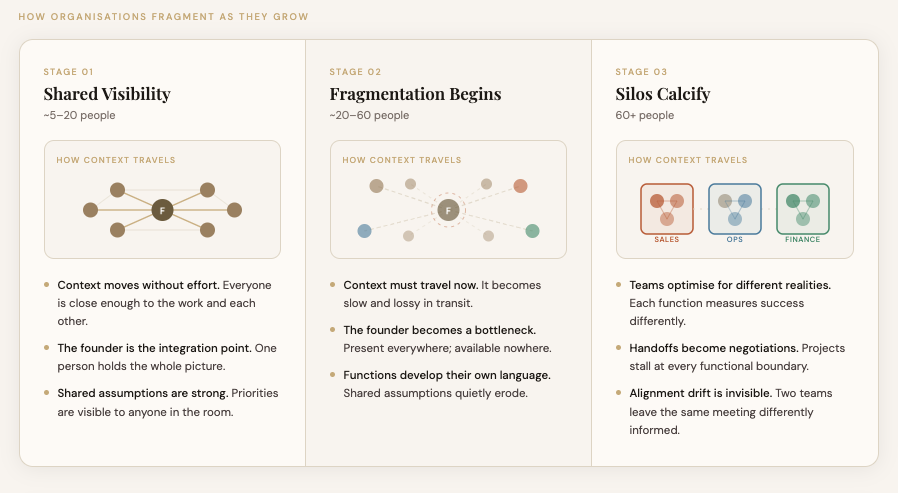
In the early stages of a business, the founder knows the major customers personally.  

All complaints reach decision-makers quickly. A customer calls with a problem, and someone immediately knows the background.

This works remarkably well — until it doesn't.

As the business faces growth, customers increase and products proliferate.  Teams specialise and new locations open. The same customer is now served by more people. And that is where complexity enters.


Why customer relationship problems are often misunderstood


When customer satisfaction begins to decline, organisations normally seek behavioural explanations: “Customer service isn’t responsive” or “Sales is overpromising” or “Operations is not customer-focused”. So employees need more training.

Sometimes these explanations are valid. Often, however, they mask a deeper structural issue.

As organisations grow, customer information becomes scattered across departments, systems, spreadsheets, conversations, and individual experiences. Every function develops its own view of the customer.


Sales sees opportunity while Operations sees workload and Finance sees risk.

Each perspective is valid but each is incomplete.


The problem is not that people stop caring about customers. It is that no one is responsible for integrating all these perspectives into a single, coherent customer view.


Customer context gets lost


Customer relationships depend on context because context gives meaning to information


A delayed delivery means something different when the customer has experienced three previous delays.


In smaller organisations, context is known by all and the customer story remains largely intact. In growing organisations the context gets twisted or curtailed so what reaches customer service may not be what sales originally promised.


What reaches finance may not include the relationship history that explains unusual circumstances.


The result is not poor service. It is fragmented service.


From the customer's perspective, however, the organisation appears disconnected.


This is customer alignment drift. It rarely happens overnight. It accumulates over time.


The hidden role of customer intelligence


Organisations that sustain strong customer relationships along with growth typically excel at customer intelligence - the ability to convert customer information into shared organisational understanding.


Every function finds the information meaningful.


When customer intelligence is shared effectively across the organisation, departments make decisions with the customer experience in mind rather than only their own functional objectives.


Without that shared understanding, every function optimises locally while the customer experience deteriorates globally.


The organisations that scale customer relationships successfully do something remarkably simple.


They build connective tissue.


They create systems, processes, and conversations that allow customer context to be shared across functions.


They ensure that customer understanding does not remain trapped inside individual departments.


As businesses grow, products can be copied, Prices can be matched. Technology can be acquired.


But a deep, organisation-wide understanding of customers remains one of the hardest competitive advantages to replicate. So building a


Customer-centric organisation ensures employees understand how their roles contribute to customer success.


Communication forms the backbone of customer relationships as it creates trust, reduces misunderstandings, and strengthens emotional connections.  In this the important principles of customer communication include: Clarity, Consistency, Responsiveness, Personalization and Empathy.


Growth should strengthen an organization's connection with its customers, not weaken it. Businesses that consciously preserve customer alignment are better positioned to sustain loyalty, drive innovation, and achieve long-term success in increasingly competitive markets


So growth creates complexity.


Customer Relationship Management exists to ensure that complexity remains invisible to the customer. 


The future belongs to organizations that manage customer relationships not as isolated activities but as strategic capabilities embedded throughout the enterprise.

Comments

Rated 0 out of 5 stars.
No ratings yet

Add a rating

Solution ONE

OWN YOUR NEXT EDGE

Address:

Hyderabad and Bangalore, India

Email:

Designed and built with intent, not just AI :)

© 2026 by Solution ONE. 

bottom of page